To repair or replace a damaged roof, you need to understand roofing basics. A square in roofing is the base of roofing that helps make a budget estimate. A roofing square is one square of the roof shingle, or 100 square feet of roof surface. A 2,000-square-foot roof is 20 squares, and when a contractor quotes $500 "per square," that price covers 100 square feet, not one.
Why Roofers Count in Squares?
Shingles, underlayment, and labor are all ordered and priced in blocks of 100 square feet, so a roof gets described as "24 squares" instead of 2,400 square feet. The unit is common in US and Canadian construction, and one square equals about 9.3 square meters, according to Wikipedia's entry on the square as a unit.
A square doesn't need to be a 10-by-10-foot patch. Any 100 square feet counts. It also has nothing to do with a square yard, which is only 9 square feet.
How Many Bundles Are in a Square?
Most asphalt shingles come in three bundles per square, with each bundle covering roughly 33 square feet. Some architectural and premium lines need four or more, so read the coverage printed on the wrapper before you order. Shingles overlap, which means the physical shingles in one square add up to more than 100 square feet. The wrapper number already accounts for that.
Weight matters too, especially if you are planning a dumpster or loading a roof deck. We broke down how much a roofing square weighs by material in a separate guide.
How to Calculate Your Roof's Squares?
The mistake that throws off most homeowner estimates is using the floor plan number. A sloped roof is bigger than the house under it, so you need a pitch multiplier.
Common Multipliers: 4/12 is 1.054, 6/12 is 1.118, 9/12 is 1.25, and 12/12 is 1.414.
Here is the mathematical calculation for a house with a 1,600 square foot footprint and a 6/12 pitch:
- 1,600 x 1.118 = about 1,789 square feet of roof
- 1,789 / 100 = 17.9 squares
- Add 10% waste, which gives 19.7, so order 20 squares.
- 20 squares x 3 bundles = 60 bundles
Put that same footprint under a 12/12 pitch, and the roof jumps to about 22.6 squares before waste. Nothing about the house changed except the slope. Also measure the roof edge, not the wall. A 40-by-30-foot house with a one-foot overhang on every side measures 42 by 32 feet, which is 1,344 square feet instead of 1,200.
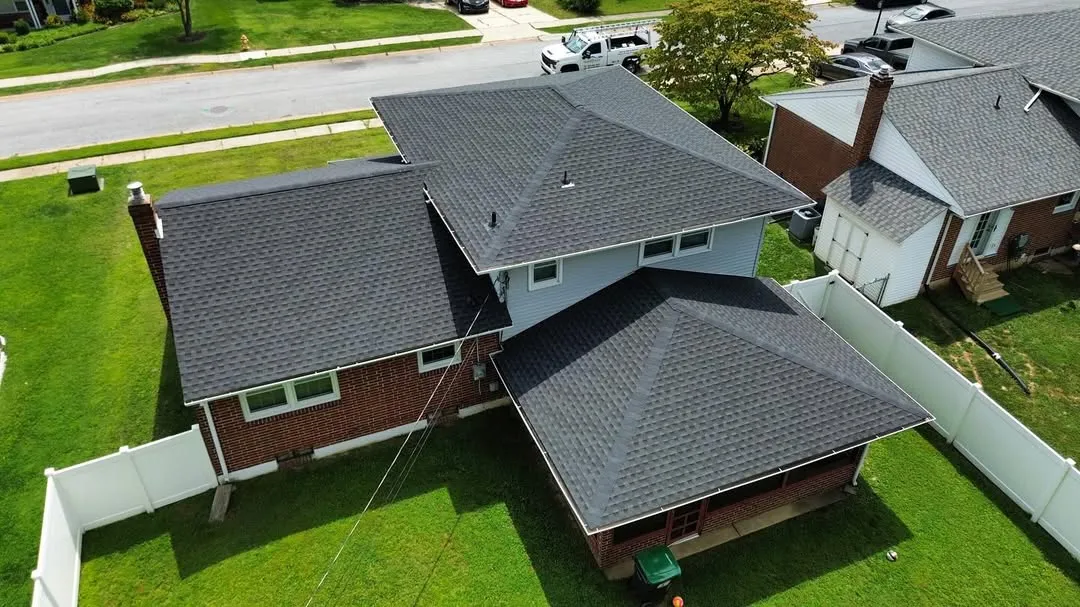
Roof shape decides the waste percentage of the shingles. A simple gable roof has two large planes and needs little cutting, so 10% is usually enough. Hips, valleys, and dormers push it to 15%, and a complicated roof can need 20% or more.
What Squares Mean for Your Quote?
Published 2026 pricing guides mention the installation cost of asphalt shingles anywhere from about $350 to $850 per square, depending on shingle grade and region. It means, for the 20-square roof above, the installation cost would be $7,000 to $17,000. The cost has a wider range because tear-off, decking repairs, and local labor rates are all included in that number.
For full-house totals, see our breakdowns for a 1,600 square foot house and a 3,000 square foot house, or the broader look at what a new roof costs.
When ordering roofing material, order enough for the project without wasting too much material, but also have some spare material to avoid midway interruption of the project. This is because when a second delivery is ordered, it will take time to get the material delivered, and the shingle color can vary slightly between production batches. Padding too much has its own cost, because you pay for bundles that end up in the dumpster.
When bids come in, ask each contractor to write down the square count, the pitch they assumed, and the waste percentage. If two quotes differ by three squares, one of them is measured wrong. Our guide on how to choose roofers covers what else to compare.