Choosing a countertop material is one of those decisions that feels minor until you're actually making it. Then suddenly you're deep in comparisons, sample swatches, and conflicting opinions from everyone who has ever renovated a kitchen.
Two materials dominate the premium countertop conversation in Canadian homes right now: quartz and porcelain. Both are beautiful. Both are durable. And both have real advantages and real limitations that matter differently depending on how your kitchen is used, what your aesthetic preferences are, and what the Canadian climate demands from interior surfaces.
What Quartz Countertops Actually Are
Quartz countertops are engineered stone. They're made from approximately 90 to 95 percent crushed natural quartz bound with polymer resin and pigments. The manufacturing process produces a surface that's highly consistent in colour and pattern, non-porous, and very hard.
Because quartz is engineered rather than quarried as a slab, the appearance can be precisely controlled. This makes it easier to achieve consistent results across large kitchen installations and to match pieces that need to align across seams.
What Porcelain Countertops Actually Are
Porcelain countertops are made from refined clay fired at very high temperatures. The result is an extremely dense, hard material that can be produced in large format slabs and finished to mimic the appearance of natural stone, concrete, wood, and other materials with remarkable accuracy.
Modern large-format porcelain slabs have transformed the material from a primarily flooring and wall tile product into a genuine premium countertop option that architects and designers are specifying at increasing rates across Canadian residential and commercial projects.
The Key Differences That Actually Matter for Kitchen Use
Heat resistance: This is where porcelain has a clear advantage. Porcelain is fired at temperatures exceeding 1200°C, which means it handles direct heat from pots and pans without damage. Quartz contains resin binders that can be damaged by sustained high heat, producing discolouration or surface cracking. While the recommended practice for both materials is to use trivets, quartz is genuinely more vulnerable to heat damage than porcelain if hot items are placed directly on the surface.
Scratch resistance: Both materials are highly scratch resistant, rating 6 to 7 on the Mohs hardness scale. In practical kitchen use, neither will scratch under normal conditions. Porcelain has a slight edge in hardness, but the difference isn't meaningful in day-to-day use.
UV resistance: Canadian kitchens with significant natural light exposure benefit from porcelain's superior UV resistance. Quartz resin can yellow or fade over time with sustained direct sunlight exposure. If your kitchen has a south-facing window that floods the countertop with light for much of the day, this is a genuine consideration.
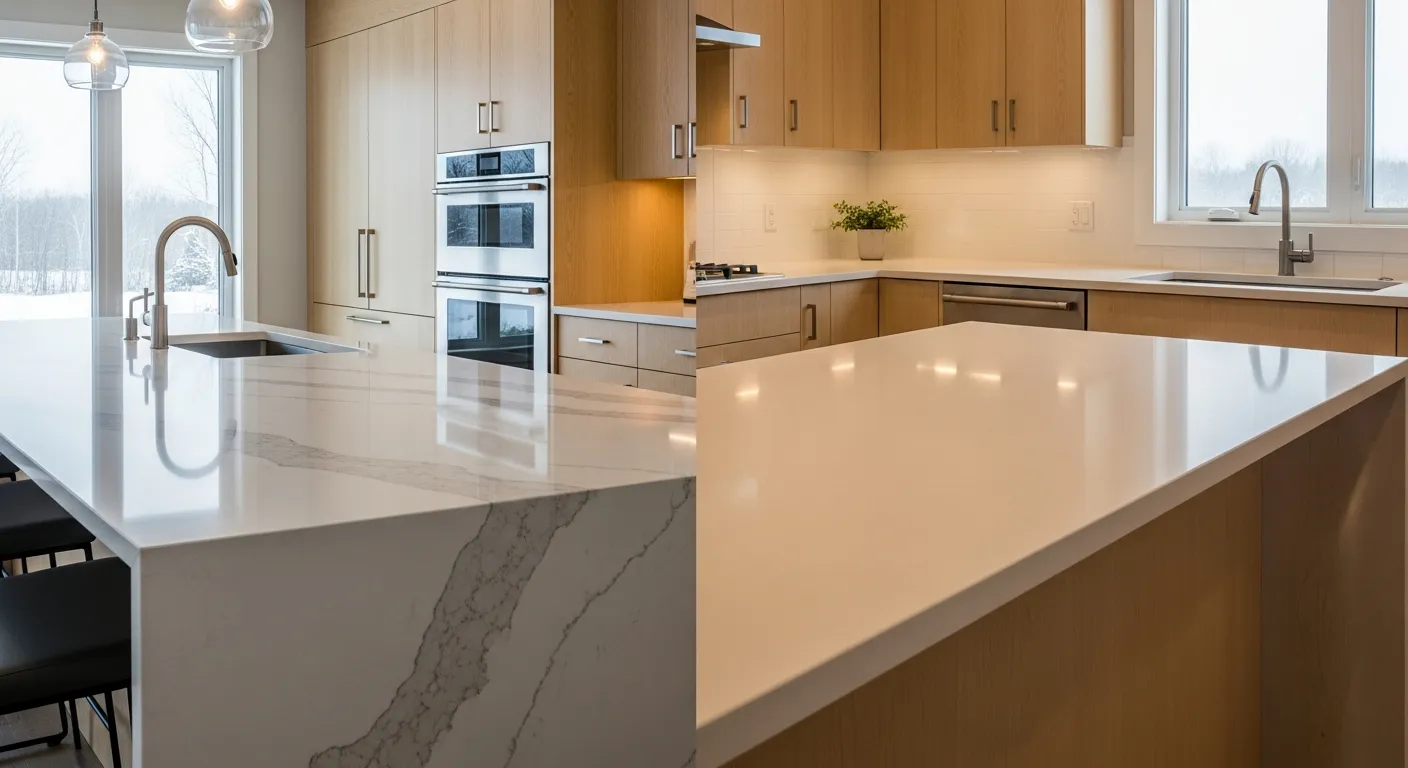
Appearance options: Quartz offers extremely consistent patterns that are predictable across an installation. Porcelain can now convincingly replicate the look of Carrara marble, slate, concrete, and wood grain with a consistency that natural stone can't provide. Both materials offer wide aesthetic ranges, and choice here comes down to the specific look you're after.
Weight: Large format porcelain slabs are considerably heavier than quartz, which has implications for cabinetry support requirements and installation complexity. Your installer needs to assess cabinet and substrate condition before porcelain installation.
Repairability: If a porcelain slab chips at a corner or edge, the repair is difficult to make invisible. Quartz can be repaired more successfully when minor damage occurs, though neither material is easy to repair to an undetectable standard.
As porcelain continues to gain popularity in Canadian kitchen design, products such as HanStone Porcelain surfaces demonstrate how far the material has evolved, offering large-format slabs and sophisticated patterns that suit both modern and traditional interiors.
Which Material Works Better for Canadian Conditions
Canada's climate creates specific conditions that influence material performance in ways that matter for long-term satisfaction.
Temperature cycling: Canadian homes experience significant seasonal temperature variation. Both materials handle indoor temperature cycling well, but the combination of radiant floor heating in cold months and air conditioning in warm months creates expansion and contraction cycles in the substrate. Your installer's approach to substrate preparation and expansion accommodation matters more than material choice in this context.
Natural light variation: Seasonal changes in natural light are significant across Canadian latitudes. If your kitchen receives sustained direct sunlight in summer but not in winter, the UV resistance advantage of porcelain becomes more relevant.
Cooking culture: Canadian home cooking culture spans everything from elaborate weekend cooking with hot cast iron to simpler weekday preparation. If you're the type of cook who transfers a cast iron skillet directly from oven to counter, porcelain's heat tolerance is a genuine practical advantage.
The Installation Consideration
Both materials require professional installation. Large format porcelain specifically requires experienced installers with the appropriate equipment and substrate preparation knowledge. The seam placement, edge profiles, and cutout execution for sinks and cooktops are all areas where installation quality determines whether the finished result looks exceptional or merely acceptable.
Always ask for references and portfolio examples when selecting an installer for either material.
Conclusion
There's no universally correct answer between quartz and porcelain. Quartz is the right choice for kitchens where consistent patterning, easier repair, and a slightly more forgiving surface are priorities. Porcelain is the right choice where heat resistance, UV stability, and the ability to achieve dramatic large-format stone looks without natural stone's variability and maintenance requirements are important.
The best countertop is the one chosen with honest consideration of how your kitchen actually gets used.