

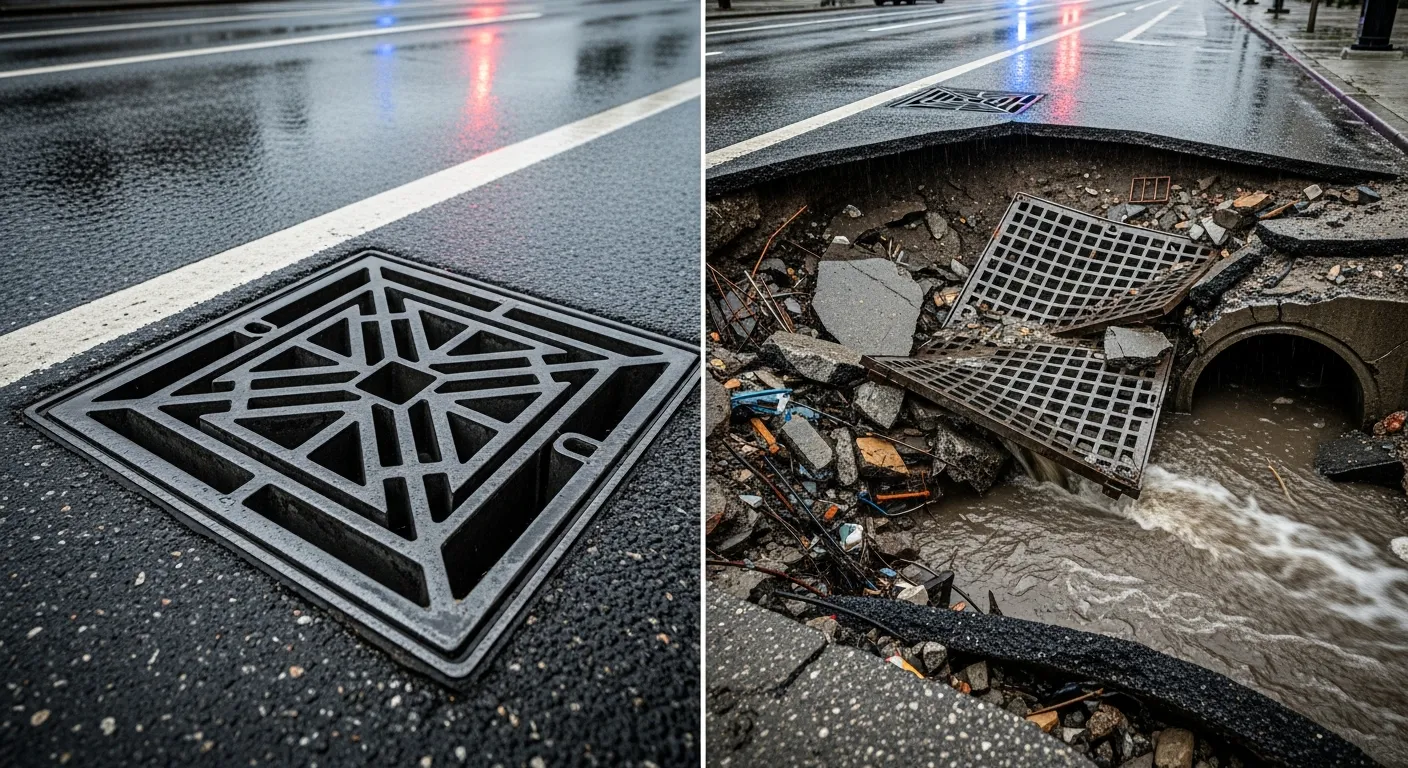
Infrastructure rarely fails in dramatic ways at first. It starts small. A slight shift, a hairline crack, a faint rattle under passing traffic. In drainage design, these early signs are easy to miss but rarely harmless. Within this broader system, steel grates carry more responsibility than they’re given credit for, managing runoff while supporting daily use.
When specified well, they disappear into the background. However, when they are not, the consequences tend to surface quickly and linger far longer than expected.
The Engineering Necessity of Material Integrity
Drainage components operate in conditions that are anything but forgiving. Constant load pressure from traffic or equipment, prolonged exposure to moisture, accumulation of debris, and fluctuating temperatures all work against the integrity of the material. It is a relentless environment where even small weaknesses are quickly exposed over time.
Lower-grade options may perform adequately at first, giving the impression of reliability. However, repeated stress cycles begin to reveal their limitations. Warping often starts subtly, almost unnoticed, as the material struggles to retain its original shape. Corrosion then sets in, accelerated by moisture and trapped debris, gradually weakening the structure. As deterioration progresses, the component loses its ability to distribute weight evenly, creating pressure points that can lead to cracking, failure, and costly repairs. That is when minor issues escalate into significant infrastructure problems.
High-quality steel, by contrast, behaves in a fundamentally different way. It resists deformation under load, handles continuous stress without compromise, and maintains its structural consistency even in harsh environments. This durability ensures that the drainage system performs as intended over a longer lifespan. That level of stability directly influences how long the surrounding infrastructure remains safe, reliable, and functional.
The Hidden Financial Burden of Substandard Selection
Budget decisions have a way of echoing far beyond their original intent. Choosing a cheaper grate may appear to reduce upfront costs, offering a quick win for tight project budgets, but the financial story rarely ends there. With time, the hidden consequences begin to surface in subtle yet persistent ways.
Maintenance teams start to notice recurring issues that weren’t anticipated at the outset. Loose fittings become more common, surface noise increases under traffic, and slight displacements begin to appear. Each of these problems demands attention more frequently than planned. Every intervention, no matter how minor it seems, carries a cost, labour hours, replacement materials, and sometimes even temporary closures that disrupt normal operations. As these interruptions add up, the cumulative expense can quickly exceed what a more durable, higher-quality installation would have required in the first place.
Beyond these visible costs lies a bigger, less obvious risk. When water is not effectively managed, it finds alternative paths. It can seep into surrounding surfaces, gradually weakening foundations and compromising structural integrity. What begins as a small drainage issue can evolve into complex, expensive repairs. At that stage, the initial savings feel negligible compared to the long-term consequences.
Prioritising Public Safety and Risk Mitigation
A drainage grate might seem like a minor detail in a larger streetscape, yet its failure can have immediate and far-reaching consequences. In pedestrian zones, even a slight distortion in the grate’s surface can disrupt what should be a smooth, continuous path. That small irregularity is all it takes for a trip hazard to emerge, particularly in busy areas where people may not be watching their footing closely. Such hazards increase the likelihood of falls, complaints, and costly repairs.
On roads or in industrial environments, the stakes are significantly higher. A compromised grate subjected to repeated vehicle loads is not merely an inconvenience; it becomes a structural risk. Failure under pressure can result in serious accidents, vehicle damage, and potential injury to drivers or nearby workers. In high-traffic settings, even a brief malfunction can disrupt operations and create safety concerns.
There is also the question of responsibility. When a failure is traced back to poor material selection or inadequate specifications, accountability quickly follows. Legal exposure becomes part of the equation, often bringing financial and reputational consequences. Investing in reliable, well-tested materials helps mitigate these risks, providing assurance that extends beyond basic compliance and supports long-term safety and performance.
Balancing Efficient Water Flow With Clean Visual Integration
Performance matters, but appearance carries its own weight in public and commercial spaces. Drainage solutions are expected to do their job, blending into the environment rather than disrupting it. In well-designed settings, these elements almost disappear into the broader architectural language, supporting both function and visual harmony.
Well-designed grates manage this balance with ease. They allow water to pass through efficiently, minimise blockages, and maintain a clean, consistent surface profile. Their integration with surrounding materials, whether concrete, stone, or tile, reflects careful planning and precision. Subtle details such as alignment, spacing, and finish contribute to a cohesive look that feels intentional rather than incidental.
When quality is compromised, that balance quickly slips. Inferior materials or poor installation can lead to misalignment, warping, or premature wear. Debris collects more easily, and water begins to linger where it should not. These issues compound gradually, turning what should be an unobtrusive feature into a noticeable flaw.
The result is not just functional decline but also a visible one. Pooled water, staining, and uneven surfaces affect how a space is perceived, experienced, and ultimately used by the people moving through it.
Installation Precision and Overall Performance
Even the highest-quality materials can underperform if installation is not handled with equal care. Drainage grates rely on precise alignment, secure seating, and proper integration with surrounding surfaces to function as intended. Small deviations during installation, such as uneven bedding, insufficient support, or poor anchoring, can introduce stress points that compromise performance over time.
These issues rarely present themselves immediately. At first, the grate may appear stable, but as traffic loads and environmental conditions take their toll, movement begins. Slight rocking under pressure, gradual loosening, or minor settlement can all develop into more pronounced structural concerns. Eventually, this affects not only the grate itself but also the adjacent pavement or flooring, leading to cracking, misalignment, and accelerated wear.
Attention to installation detail ensures that the material’s inherent strength is fully utilised. Proper support distribution, accurate levelling, and secure fixing methods all contribute to a system that behaves consistently under load. When installation is executed correctly, it reinforces the durability of the material and helps maintain the integrity of the entire drainage system, preventing avoidable failures that stem not from what was chosen, but from how it was put in place.
Final Thoughts
Decisions made during specification often feel routine. Another line item, another material choice, another detail to finalise before moving on. Yet some of these decisions carry weight well beyond their immediate scope, influencing performance long after construction ends.
Drainage components fall firmly into that category. Their role is constant, managing water flow day in and day out, and their impact is cumulative over time. When overlooked, they can become a source of persistent issues. But when carefully considered, they contribute to smooth operation and long-term reliability. Getting it right from the outset reduces future complications, limits costly disruption, and supports the broader integrity of the built environment.
There is a certain clarity in choosing well-tested, durable solutions. It removes uncertainty during installation and beyond. Also, it simplifies maintenance for those responsible later. Most importantly, it ensures that something as unassuming as a grate continues to perform without issue, long after the project itself has been completed and handed over.

