

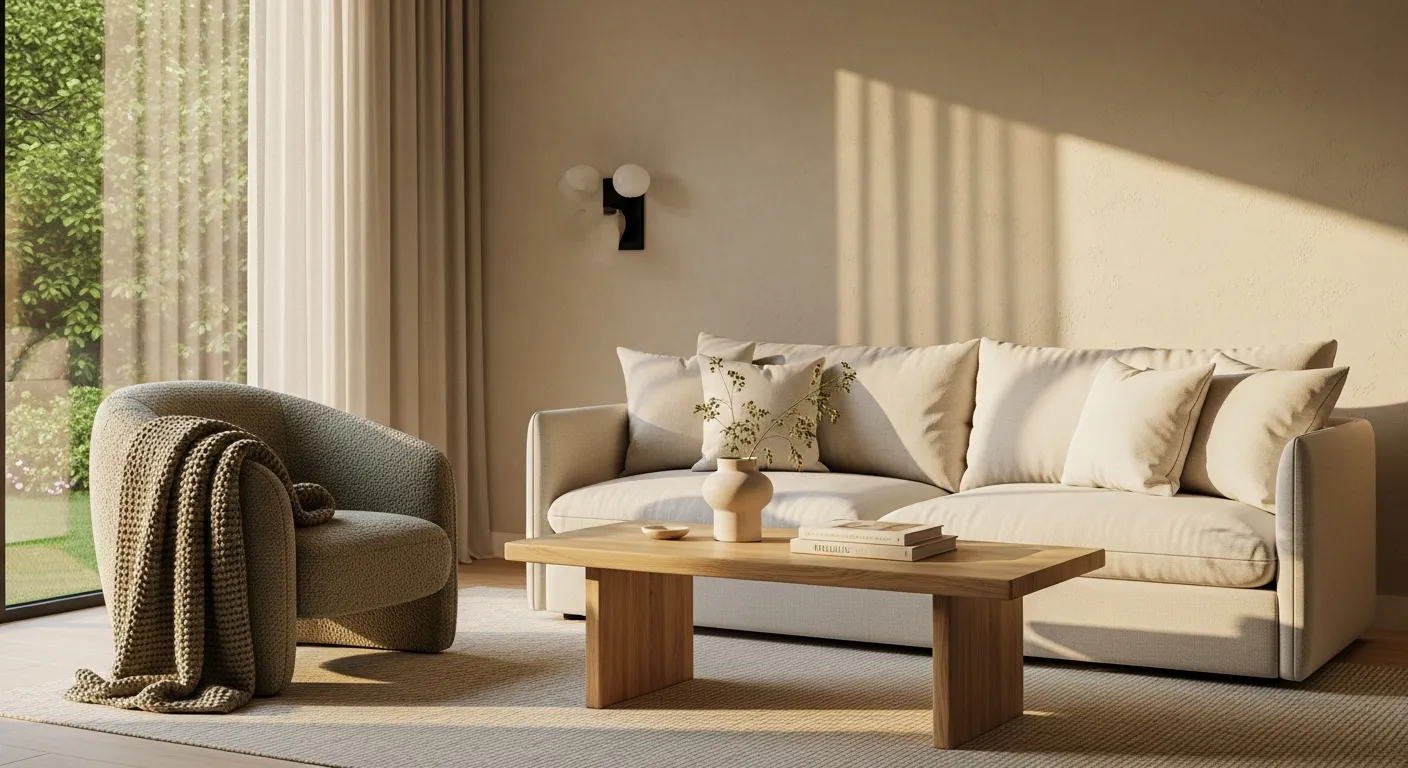
The living room has a sofa, a coffee table, and a rug. The pieces are good quality and the colours are not far off. But sitting in the room never quite feels restful. Something about it is mildly uncomfortable in a way that is hard to name.
This is one of the most common interior design frustrations, and it almost never comes down to taste. The pieces are fine. What is off is the relationship between them — the scale, the palette, the way they are arranged in the space, the fact that some essential thing was not thought through before buying started.
What Feeling Are You Going for?
This is worth settling before looking at a single product. How do you want the room to feel when you are in it — on a normal Tuesday evening, when the house is reasonably tidy and the light is getting low?
Cosy and enclosed, with warm textures and soft lighting? Open and airy, with pale woods and neutral linen? Calm and edited, with very little visual noise? Earthy and natural, with plenty of wood and plants? The answer to this question decides which furniture will serve the room and which will undermine it. A beautiful piece in the wrong register — a sleek minimalist sofa in a room that wants warmth, or a heavily textured boucle chair in a room that wants to feel fresh and light — will never quite settle.
Start With the Biggest Piece
In most rooms, one piece of furniture is doing more visual work than anything else. In a living room it is almost always the sofa. In a bedroom it is the bed. In a dining space it is the table.
When browsing furniture online, it is much easier to make confident choices when pieces are shown in a full room setting; this is one reason brands use 3d rendering services to present sofas, chairs, tables, and storage in realistic home interiors. Lifestyle photography that shows a sofa in a full room — walls, rug, other furniture — tells you something that a product shot against a white background cannot. The proportions become legible. You can see whether the piece looks settled or slightly stranded.
Choose this anchor piece first, and choose it specifically for the room it is going into. The colour of the walls, the tone of the flooring, the amount of natural light, how large the room actually is — all of these should come before falling in love with the piece itself.
Getting the Scale Right
The scale problem in furnished rooms tends to look the same: something is too big, or there are too many pieces, or the room has been filled to capacity when it would have worked better with less.
Write down the key measurements before browsing anything. Not just the wall length — the walking path through the room, the distance from the sofa to the coffee table when someone is sitting down, the clearance needed to get around the dining table when chairs are pushed back. These are the numbers that determine whether daily life in the room feels easy or slightly awkward.
A coffee table positioned too close to the sofa means everyone is constantly shuffling it out of the way. A sideboard too deep for a hallway blocks the natural movement through the house. A bed placed without enough clearance on one side means starting every morning with an obstacle. None of these problems are visible in a product listing, and all of them are obvious within the first week.
Colour and How Pieces Connect
Furniture that was chosen without reference to the wall colour, the floor, and the existing pieces tends to make a room feel assembled rather than considered. The individual items are reasonable but they are not talking to each other.
A workable approach: look at what the room already contains and find the underlying undertone. Warm floors and warm walls — anything with yellow, pink, or red in it — tend to work more naturally with furniture in warm tones: honey oak, warm cream upholstery, terracotta accents. Cooler spaces — grey stone floors, blue-grey walls — tend to sit better with furniture in cooler directions. The pieces do not need to match. They need to be pulling in the same direction.
For larger purchases, realistic room scenes created through furniture rendering services can help shoppers compare scale, finishes, fabric colours, and how a piece may work with the rest of the room. For everyday decisions, holding paint chips and fabric swatches alongside the flooring and wall colour — in the actual light of the room — does most of the same work.
Mixing Styles
Rooms that feel personal almost never contain only one style of furniture. The interest comes from mixing, and the trick is in what gets repeated across the pieces.
Repeating a material threads everything together even when the individual pieces are quite different. If there is natural oak in the dining table, a small oak side table or a wooden frame on a picture pulls the room into a family. The same works with metal finishes — a brushed brass lamp and a brushed brass candle holder are enough to make the brass feel like a decision rather than an accident.
And keeping the visual weights roughly in agreement helps. A very large, substantial sofa alongside a very delicate occasional chair often feels unresolved in ways that are hard to articulate. Pieces that feel proportionally related tend to sit together more easily.
Storage as Part of the Room
A home that has no convenient place to put everyday things will always look slightly cluttered, even when effort goes into tidying it. Storage is one of those things that sounds unglamorous and makes an enormous practical difference.
Sideboards and credenzas. Shelving with baskets underneath. A hallway bench with drawers. A bedside table with an interior rather than just a surface. The goal is not to hide everything, but to give ordinary things a home — so that the room can be returned to calm without a major project.
The Softer Layer
Once the main furniture is right and storage is sorted, the accessories do the final work of making a room feel personal.
Rugs define and warm a seating area. Cushions and throws add texture and make sitting genuinely comfortable. Lamps create the kind of low, pooled light that makes a room feel much more intimate in the evening than overhead lighting alone achieves. Plants, books, a few meaningful objects — these signal that a real person with particular tastes lives in the room.
The soft layer should follow from the furniture rather than lead it. When the furniture plan is already settled, even modest accessories can feel cohesive and deliberate.
Choosing furniture that makes a home feel like a sanctuary is mostly about making decisions in the right order and with some awareness of how everything relates. The pieces do not need to be expensive or perfectly matched. They need to feel like they belong in the same room, and like the room belongs to whoever lives in it.


