


You want that airy, boutique-hotel vibe every time you step into the bathroom, yet the vanity must feel rock-solid when the kids lean on it. Wall-mounted double vanities now deliver both, moving from design-blog eye candy to mainstream must-have. Houzz’s latest study shows wood-tone cabinets edging out classic white—26 percent of renovators pick wood versus 22 percent white—proof that buyers crave warm pieces that float off the floor.
We sifted manuals, installer forums, and owner reviews to rank seven vanities that won’t budge once bolted up. Follow our guide to choose the one that fits your budget, your style, and your studs—starting with Willow Bath & Vanity.
Why You Can Trust This Ranking
We didn’t just scroll a shopping site and screenshot pretty vanities. Instead, we built a long list of fifteen well-reviewed North-American models and ran each one through a seven-point scorecard focused on what keeps a wall-hung cabinet secure and user-friendly.
Construction came first. Solid hardwood frames, marine-grade plywood, and dovetail joints earned top marks, while thin particleboard panels lost them quickly.
Next, we graded mounting systems. A full-length steel rail or French cleat that hits multiple studs scored far higher than two lone screw holes. Manuals that call for extra blocking, or better, include it, signaled thoughtful engineering, not overkill.
Storage, style, installation ease, price-to-value, and sustainability covered the rest of the matrix. Build quality and support hardware still carried forty percent of the total, so a beautiful vanity slid down the list if its hanging system felt like an afterthought.
Finally, we double-checked the leaderboard against contractor forums, owner photos, and warranty records. If users reported sagging drawers or cracked tops, we adjusted the scores.
The result is a tight list of seven vanities we’d recommend to a close friend: pieces that look great in your feed and stand up to wet towels, morning traffic, and the occasional toddler chin-up.
1. Willow Bath & Vanity “madison” 84″: Best Overall

1. Willow Bath & Vanity “Madison” 84″: best overall
Picture a solid-teak sideboard floating off the floor and you have Madison. At seven feet wide it fills a primary bath with resort calm while staying visually light. Ten full-extension drawers provide organized storage, giving each partner a dedicated bank and leaving room for towels in the center.
Willow builds the cabinet from furniture-grade teak, not a thin veneer. The continuous grain across drawer fronts is sealed in a marine-grade finish that shrugs off humidity. Inside, dovetail joinery and soft-close hardware show real craftsmanship rather than fast-furniture flair.
A powder-coated steel rail spans the full width. Level it on blocking, lag it into at least three studs, and the vanity clicks on like a large French cleat. Once the quartz or marble top drops into place, weight transfers straight back into the wall, eliminating flex or creaks.
Customization is Madison’s ace. Order the cabinet only and choose your own stone, or select from Willow’s quartz palette cut as a single slab. Plumber-friendly cutouts run full height behind each sink, so rough-ins never fight deep drawers.
Yes, it costs more than some full bathroom renovations, but if you want a centerpiece that still feels current ten years from now—and one your wall studs can trust—Madison earns the top spot.
2. James Martin “marcello” 72″: Classic Luxury

If Madison feels resort modern, Marcello reads five-star hotel. James Martin builds the frame from kiln-dried birch and applies a furniture-grade finish that looks more living-room credenza than bathroom cabinet. The chestnut stain highlights subtle grain, and satin-nickel pulls deliver a restrained shimmer.
Open the top drawers and you’ll find neat organizers for toothpaste, floss, and moisturizers. Below, two deep cabinets store larger bottles, and soft-close glides keep the morning routine quiet.
Mounting strength matches the looks. Marcello hangs on a full-length French cleat that bolts into studs or blocking. After the cabinet seats, its three-centimetre quartz top distributes weight across the frame. Installers appreciate that drawer fronts ship off the cabinet, so they lift a lighter shell, square it, then slide drawers back in.
At seventy-two inches wide there is room for two people to brush without bumping elbows, and the shallow nineteen-inch depth keeps walkways open. Choose white, grey, or chestnut for a vanity that nods to tradition without feeling dated.
The price sits in the premium tier, but you get a cabinet that looks polished closed or open and feels solid every time you pull a drawer.
3. Kohler Parallel 60″: Easy All-in-one Solution
Need a vanity that arrives ready to hang and plumb? Parallel ships pre-assembled with a seamless cultured-marble top already bonded to the cabinet, so you avoid juggling loose stone or sinks.
The frame measures a slim 21.5 inches deep, letting doors swing clear in tighter baths. Two push-to-open drawers manage daily toiletries, while twin door sections corral towels or a hair-dryer caddy. All hardware is soft-close and feels more upscale than its mid-two-thousand price.
Mounting is straightforward. A powder-coated steel rail spans the back; level it, lag into two studs, and lift the cabinet on. Because the top is integrated the load stays modest, lightening strain on both installers and wall.
A high-gloss lacquer wipes clean in seconds, although bright finishes reveal toothpaste spots if left un-wiped. Pair Parallel with wall-mount faucets for a spa feel or use the pre-drilled deck holes for standard mixers. Either way, you get a turnkey package from a brand plumbers already trust, making Parallel the stress-free route to a floating double vanity.
4. Lexora Geneva 60″: Best Value
Geneva shows you can secure real marble and solid-wood framing without blowing the renovation budget. The cabinet ships in navy, grey, or white and includes a thick Carrara slab with undermount sinks already polished. A matching mirror comes in the box, keeping the full package near fifteen-hundred dollars.
Construction exceeds its price tier. Lexora starts with an oak-ply core and reinforces drawer boxes with dovetail corners, a detail many rivals skip when cutting cost. Full-extension slides reach the back of all four drawers, and doors under each sink swing wide for bulky cleaners or extra toilet paper.
Installers like the fully open back. Plumbing stubs need less precision, and a steel mounting bracket spans the width so you can secure multiple studs even in older framing.
For shoppers who want premium touches at a mid-market price, Geneva leads the pack.
5. Blossom Positano 60″: Trend Pick With Fluted Flair
If your inspiration folder is packed with reeded wood and curved tambour panels, Positano delivers. Vertical flutes run across each drawer front, catching light and adding texture without feeling gimmicky. In glossy white the pattern reads coastal and fresh; in espresso it looks rich and architectural.
Beneath the style, function stays practical. Four deep drawers glide on soft-close metal slides and frame an open centre shelf, perfect for rolled towels or a small décor piece.
Positano trades heavy stone for a seamless cast-acrylic top, so there are no grout lines to scrub and the lighter weight is easy for two people to lift. Oversized drain and supply cut-outs handle minor plumbing offsets without extra drilling.
Mounting follows a classic cleat approach: level the included steel bar, secure it to three studs, and hang the cabinet. The lighter acrylic sinks ease pressure on older framing.
The cabinet also grows with you. Blossom sells narrow matching side units to add vertical storage if towels pile up. For anyone chasing the wood-textured trend without commissioning a custom build, Positano offers standout style at a mid-range price.
6. IKEA Godmorgon 55″: best budget

When you want the floating look for the cost of a short getaway, Godmorgon delivers. Cabinet, double sink, and drawer organizers together land at roughly six hundred dollars, leaving room in the budget for upgraded faucets or new tile.
The carcass is particleboard wrapped in water-resistant foil. It is not heirloom material, yet thousands of rentals show it survives daily splashes when edges are sealed. Two large drawers slide smoothly and hide molded bins that keep toothpaste and hair ties from drifting.
Mounting uses a galvanized steel rail. Level it, hit two studs, and hang the cabinet. The ceramic double sink is relatively light, so each fastener stays well within the manual’s 143-pound combined limit.
A few pro moves elevate the result. Swap stock chrome handles for matte black pulls, run a thin bead of silicone along every raw edge before installation, and tighten lag bolts into solid wood, never drywall anchors. Follow those steps and you will enjoy a clean, modern double vanity that costs less than many single-sink tops.
7. Fine Fixtures Atlus 48″: Best for Small Bathrooms
Sometimes you need two sinks but only have four feet of wall. Atlus fits that brief at forty-eight inches without making the room feel cramped. A seamless acrylic top molds both basins into one easy-to-wipe surface, so every inch works for you instead of disappearing into grout lines.
The cabinet is a sleek MDF box finished in high-gloss paint that bounces light and makes tight quarters feel larger. Two full-width drawers handle hair tools and skincare, and a U-shaped cutout keeps plumbing tidy without stealing storage.
Because the vanity is compact and the top is lightweight, installation is kinder on older plaster walls. A metal cleat runs the full width; anchor it to two studs, hang the cabinet, and you are done. If the studs are off-centre, add a three-quarter-inch plywood ledger to bridge the gap and spread the load.
Elbow room is the trade-off: partners will stand closer, and counter space is limited. Still, in condos, guest suites, or any bath under seventy square feet, Atlus gives you a rare double vanity that fits without hitting the shower door.
Choose glossy white for a gallery-clean look or charcoal to contrast light tile. Either way, you gain a second sink where many designers would default to one.
Quick Comparison at a Glance
You have met each contender up close. Before we move to installation tactics, use this grid to confirm which vanity fits your space, build grade, and budget.
| Model | Width | Construction | Countertop | Storage | Mounting hardware | Starting price |
| Willow Madison | 84″ | Solid teak | Quartz or marble | Ten drawers | Steel rail and bolts | $3,500 |
| James Martin Marcello | 72″ | Birch hardwood | Three-centimetre quartz | Four drawers, two doors | French cleat | $3,000 |
| Kohler Parallel | 60″ | Engineered wood | Integrated cultured marble | Two drawers, two doors | Steel rail | $2,000 |
| Lexora Geneva | 60″ | Oak-ply frame | Carrara marble | Four drawers, two doors | Steel bracket | $1,500 |
| Blossom Positano | 60″ | Solid-wood core | Integrated acrylic | Four drawers, shelf | Steel cleat | $1,800 |
| IKEA Godmorgon | 55″ | Foil-wrapped particleboard | Ceramic | Four drawers | Steel rail | $600 |
| Fine Fixtures Atlus | 48″ | High-gloss MDF | Integrated acrylic | Two drawers | Steel cleat | $900 |
Notice how heavier stone tops pair with full-length cleats, while lightweight acrylic tops use simpler rails. Small footprints suit Atlus and Godmorgon, whereas expansive primary baths lean on Madison’s eighty-four-inch span.
Sizing Your Vanity: Width, Height, and Elbow Room
Start with a tape measure, not a mood board. The sweet spot for genuine double-sink comfort is 60 inches or more, giving each user about 15 inches from centre of drain to the nearest obstacle. We included a 48-inch option, but treat it as a smart compromise, not the new norm.
Depth matters too. Most floating cabinets sit between 19 and 22 inches deep. Go beyond that and the vanity crowds the floor, shrinking walk paths in narrow baths. Measure from the finished wall to the nearest door swing or shower glass and aim for at least 36 inches of clear passage once the vanity is installed.

Height is the final lever. Because the cabinet hangs on the wall, you can mount it anywhere between 32 and 36 inches to the countertop. Stay closer to 32 inches if kids use the space daily, land near 34 inches for most adults, and push higher only if everyone in the household tops six feet. Keep rough-in plumbing at least three inches below the planned drawer bottoms or you will carve U-shapes on installation day.
Get those three numbers (width, depth, height) locked before you fall for a finish or trend. They decide which catalogue pages stay in play and save you from return headaches later.
Wall Preparation and Support: The No-fail Recipe
A floating vanity is only as strong as the wall behind it. That wall needs three elements: solid lumber for bite, fasteners rated for the load, and a mounting bar that spans multiple studs.
Start during framing when possible. Install a 2 × 6 horizontal block between studs at the exact height of the vanity rail. Lag bolts then grip a full 1.5 inches of wood instead of the narrow stud edge. Remodeling an existing bath? Remove a drywall strip, add the blocking, and patch. A one-hour detour now prevents an expensive failure later.
Next, choose the right screws. Skip drywall anchors. Use three-inch structural lags or cabinet screws rated for at least 150 pounds. Drive two into every stud the rail crosses. For metal studs, insert a wood block inside the channel or use heavy-duty toggle bolts rated for shear, not just pull-out.

Finally, level the mounting rail perfectly. Even a quarter-inch sag will show once a stone top rests on the cabinet. Shim behind the bar, not under the vanity, so weight still bears on solid wood.
Follow these three steps (blocking, structural fasteners, and a level rail) and the vanity becomes one with the wall. You can lean in to wash your face, rest a knee while shaving, or stack shampoo in the drawers without a hint of wobble.
Installation Flow: From Box to Rock-solid in Five Moves
Unbox the vanity in the bathroom, not the hallway, to avoid door dings. Leave the protective film on until a final wipe-down so sharp screws never touch the finish.
- Dry-fit the cabinet on a scrap two-by-four ledger screwed just below the mounting rail. The ledger carries the full load while you level and shim the back. After the cleat holes align with blocking, drive structural screws and remove the ledger.
- Remove drawers and doors before lifting the stone or acrylic top into place. The lighter shell is easier to handle, and you gain fingertip access to interior fasteners.
- Run a continuous bead of 100 percent silicone along the rear edge of the countertop, then seat it. The seal keeps splash water from softening drywall paper.
- Install P-traps and supply lines while drawers are still out. Use quarter-turn shut-offs and braided hoses so future cartridge swaps take minutes, not a service call.
- Caulk the joint where cabinet meets tile. The thin line works as an early warning strip; if it cracks, tighten mounting bolts before a gap appears.
- Follow these five moves and your vanity will feel like built-in furniture from day one.
Plumbing and Faucet Planning: Avoid the Drawer Crash
Wall-hung vanities expose every supply line and the P-trap, so everything must tuck inside the cabinet’s back cavity and above moving drawers. Miss the height window and you will notch wood or surrender storage to a bulky trap.
Set the drain outlet about eighteen inches above the finished floor. That leaves four to six inches of clearance before the top drawer opens on most cabinets. Keep hot and cold shut-offs at the same height or slightly higher so hoses loop down rather than up.
Choose the right trap. Traditional J-bends consume vertical space. A shallow bottle trap or low-profile plastic kit can save the top drawer. Chrome bottle traps from European suppliers look sharp in open backs, but even white PVC versions disappear once drawers slide in.
Faucets affect plumbing as much as style. Wall-mount faucets clear counter space and provide extra basin room, yet they require rough-in before tile and precise stub locations. Deck-mount faucets install later and allow a bit of play, but add three holes to clean. Decide early; faucet spread tells your stone fabricator how many holes to drill.
Always read the vanity spec sheet for maximum trap depth and drawer cut-out dimensions before buying fixtures. Five minutes with the document now prevents long hours of retrofitting later.
Smart Storage Around a Floating Vanity
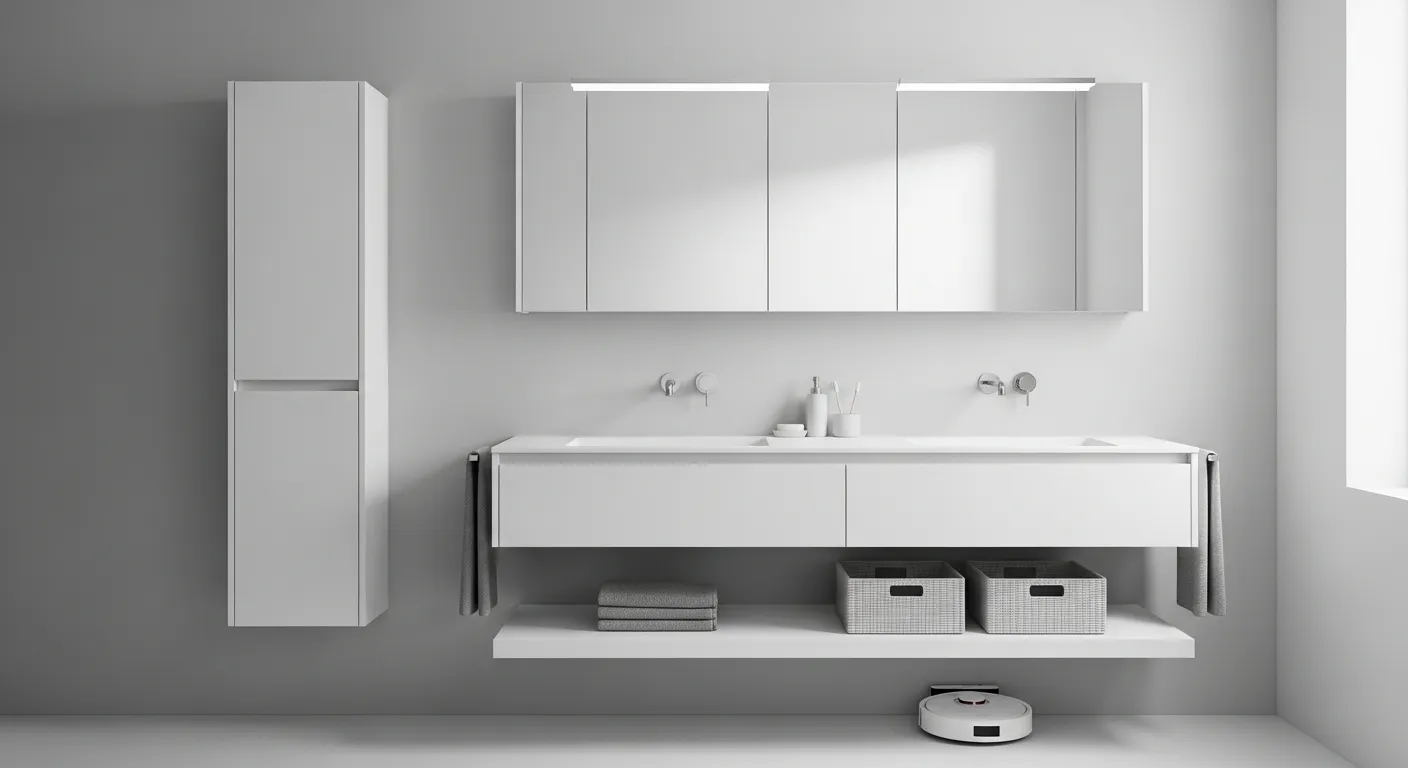
Floating cabinets reveal floor space, yet the open gap can trick you into thinking you have lost storage. Use the vertical plane to win it back.
First, add a recessed or surface-mount medicine cabinet above each sink. Even a slim four-inch-deep box swallows vitamins, contact-lens solution, and skincare—items that usually crowd the counter. Mirrored doors bounce light, doubling the sense of openness created by the floating cabinet.
Next, consider a matching wall tower. Brands such as Blossom sell twelve-inch side cabinets that mount at the same height as the main unit and create a unified line. If your vanity lacks a companion piece, install a painted open shelf to hold rolled towels without stealing visual space.
Make use of the area beneath the cabinet. Two low baskets slide under most vanities and keep extra toilet paper or children’s bath toys contained yet accessible. Choose woven resin over natural rattan; it resists damp mops and shower steam.
Inside the drawers, shallow dividers outperform deep bins because nothing gets buried. IKEA Godmorgon organizers fit almost any sixteen-inch drawer depth and cost less than a coffee break.
Combine these small upgrades and a floating vanity will store as much as a freestanding one, while still letting a robot vacuum glide underneath for the easiest bathroom clean of your life.
Conclusion: Maintenance and Upkeep
Wall-hung vanities age well when you give them quick check-ups.
Each spring, empty the top drawers and inspect behind them. Tighten every lag bolt a quarter-turn with a socket wrench; wood fibres compress over time, and that small tweak keeps the rail snug.
Next, examine the silicone seam where countertop meets wall. If you see gaps or mildew, scrape the joint clean, wipe with alcohol, and lay a fresh bead. Ten minutes here stops water from wicking into drywall.
Wipe drawer interiors with a damp microfiber cloth, then follow with a dry pass. On solid-wood fronts such as Madison or Marcello, finish with a thin coat of furniture wax to seal pores without leaving residue. For high-gloss laminates, skip wax and clean with a pH-neutral spray. Use non-abrasive pads on cultured-marble or acrylic tops to avoid scratching.
Finally, ensure P-trap nuts are snug and supply valves turn freely. A drip inside a floating cabinet can stay hidden until drawer bottoms swell. Five seconds of valve testing prevents expensive repairs.
Follow this routine once a year and your vanity will feel as sturdy and fresh as the day it went up


